8 Best Stubby Impact Wrenches for Tight Spots (October 2026)
The best stubby impact wrenches for tight spots include the DeWalt DCF921B ATOMIC 1/2 Inch Impact Wrench for controlled 1/2 in fastening, the Milwaukee 2563-20 M12 FUEL Stubby 1/2 Inch Impact Wrench for a short 1/2 in body, and the Milwaukee M12 FUEL Stubby 3/8 Inch Impact Wrench for tight 3/8 in access.
On this page (7 sections)
- The best stubby impact wrenches for tight spots
- How we chose these stubby impact wrenches
- Which drive size works best in a tight space?
- How much torque do you need from a stubby wrench?
- What control features help with fastening?
- Do battery platforms affect which stubby wrench to buy?
- Which stubby impact wrench should you choose?
The best stubby impact wrench for tight spots is the DeWalt DCF921B for buyers who want a 1/2 in drive and adjustable control. If body length matters most, the Milwaukee 2563-20 is 4.9 in long, while the Milwaukee 3/8 in Stubby measures 4.8 in.
Stubby describes a compact form, but it doesn't guarantee a tool will fit every cramped space. Check the wrench body, socket, battery and surrounding parts together, then choose a drive size that matches your fasteners.
For a broader view of compact choices, start with our best 3/8 drive cordless impact wrenches. If the work includes wheel fasteners, our guide to impact wrench size for lug nuts can help narrow drive and power needs.
Our picks at a glance
-
1
 Best for controlled 1/2 in fastening
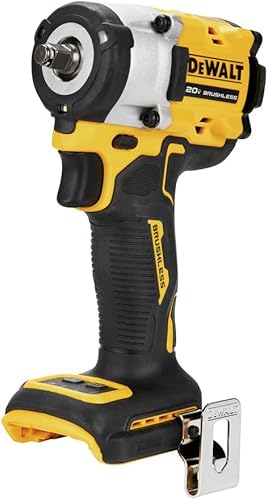
DeWalt DCF921B ATOMIC 1/2 Inch Impact Wrench
8.8/10 our score
See it on Amazon -
2
 Best for a short 1/2 in body
Milwaukee 2563-20 M12 FUEL Stubby 1/2 Inch Impact Wrench
8.4/10 our score
See it on Amazon -
3
 Best for tight 3/8 in access
Milwaukee M12 FUEL Stubby 3/8 Inch Impact Wrench
8.1/10 our score
See it on Amazon
- 4
 Check it
DeWalt DCF923B ATOMIC 3/8 Inch Impact Wrench
Best for adjustable 3/8 in control - 5
 Check it
DeWalt DCF903B 12V MAX 3/8 Inch Impact Wrench
Best for 12V 3/8 in work - 6
 Check it
DeWalt DCF901B 12V MAX 1/2 Inch Impact Wrench
Best for 12V 1/2 in sockets - 7
 Check it
Makita XWT15Z 18V LXT 1/2 Inch Compact Impact Wrench
Best for 18V 1/2 in control - 8
 Check it
Makita XWT12ZB 18V LXT Sub-Compact 3/8 Inch Impact Wrench
Best for 18V 3/8 in access
The best stubby impact wrenches for tight spots
The DeWalt DCF921B is the strongest all-around match in this group for control and 1/2 in sockets. The shorter Milwaukee models are better starting points when a compact body is the main need.
DeWalt DCF921B ATOMIC 1/2 Inch Impact Wrench: Best for controlled 1/2 in fastening
- Up to 300 ft-lb fastening torque
- Four speed settings
- Precision wrench control
- 9.2 in long
Four speed settings and precision wrench control give you ways to manage fastening. Its 1/2 in drive suits buyers who want the socket size common for larger automotive fasteners.
Pros
- Precision wrench control helps prevent overtightening and fastener run-off
- LED with brightness control
- Hog ring anvil for socket changes
Cons
- Longer than the Milwaukee Stubby models here
- Battery and charger are not included
The DCF921B pairs a 1/2 in drive with four speed settings and precision wrench control. DeWalt says that control helps prevent overtightening and fastener run-off, which is useful when you want more control during fastening.
Its body measures 9.2 in, so it is not the shortest option here. Compare the full tool and battery shape against the space around the fastener before choosing it for deep or narrow access.
A hog ring anvil supports rapid socket changes, and an onboard LED has brightness control for dim work areas. DeWalt states up to 300 ft-lb of fastening torque and 450 ft-lb of breakaway torque.
The bare tool makes the most sense if you already use compatible DeWalt 20V MAX batteries. Pick it for its control features and 1/2 in drive, rather than for the shortest length.
Milwaukee 2563-20 M12 FUEL Stubby 1/2 Inch Impact Wrench: Best for a short 1/2 in body
- 4.9 in long
- 1/2 in drive
- Four-mode DRIVE CONTROL with Auto-Shut Off
- Bare tool
The 4.9 in body makes this the shortest stated 1/2 in option in this group. Its four-mode control and compact length fit buyers who need a short tool around nearby parts.
Pros
- Shortest stated length among these picks
- Four-mode DRIVE CONTROL
- 1/2 in drive
Cons
- Battery and charger are not included
- Check access around the socket as well as the tool body
The Milwaukee 2563-20 is the shortest stated 1/2 in option in this roundup at 4.9 in long. That length may help when a longer wrench body would meet nearby parts, though socket clearance still matters.
It uses the M12 platform and has four-mode DRIVE CONTROL with Auto-Shut Off. Those controls make it a useful candidate for buyers who want a short body with multiple operating modes.
The tool is listed as a bare tool, so plan for a compatible M12 battery and charger. Check the actual fastener and socket combination before assuming the shorter body can reach it.
Choose this Milwaukee when compact length and a 1/2 in drive are your main priorities. For a longer 1/2 in option with documented speed settings, compare the DCF921B above.
Milwaukee M12 FUEL Stubby 3/8 Inch Impact Wrench: Best for tight 3/8 in access
- 4.8 in long
- 3/8 in drive
- Bare tool
- Milwaukee states up to 550 ft-lb nut-busting torque
Its 4.8 in length and 3/8 in drive suit compact access where a smaller socket setup fits the fastener. Milwaukee states up to 550 ft-lb of nut-busting torque.
Pros
- Short 4.8 in body
- 3/8 in drive
- Compact option for smaller sockets
Cons
- Battery and charger are not included
- A 3/8 in drive may not match every lug nut socket
The Milwaukee M12 FUEL Stubby 3/8 in measures 4.8 in long, the shortest stated body in this group. Its smaller drive suits work where 3/8 in sockets fit the fastener and surrounding space.
Milwaukee states up to 550 ft-lb of nut-busting torque. Treat that as a maker figure, not a guarantee for every stuck fastener or an instruction for tightening.
This is a bare tool, so you need a compatible M12 battery and charger. Confirm that the socket size and drive match the job before choosing it for automotive work.
Choose it for short-body access and a 3/8 in drive. If your lug nut sockets are 1/2 in, the Milwaukee 1/2 in Stubby or DeWalt DCF921B may be a more direct fit.
DeWalt DCF923B ATOMIC 3/8 Inch Impact Wrench: Best for adjustable 3/8 in control
- Up to 300 ft-lb fastening torque
- Four speed settings
- Precision wrench control
- 9.2 in long
This 3/8 in DeWalt pairs four speed settings with precision wrench control. Choose it if you want those controls and already use compatible DeWalt batteries.
Pros
- Precision wrench control helps prevent overtightening and fastener run-off
- LED with brightness control
- Hog ring anvil for socket changes
Cons
- Longer than the 4.8 in and 4.9 in Stubby models here
- Battery and charger are not included
The DCF923B gives DeWalt 20V MAX users a 3/8 in drive with four speed settings. Its precision wrench control is designed to help prevent overtightening and fastener run-off.
At 9.2 in long, it is longer than both Milwaukee Stubby models above. Consider it when you value the control features and battery platform more than the shortest possible tool body.
The hog ring anvil supports quick socket changes, and its LED has brightness control. DeWalt states up to 300 ft-lb of max fastening torque and 450 ft-lb of max breakaway torque.
Choose the DCF923B if your sockets are 3/8 in and you want the DeWalt controls. For an especially short body, compare its length with the Milwaukee M12 Stubby before buying.
DeWalt DCF903B 12V MAX 3/8 Inch Impact Wrench: Best for 12V 3/8 in work
- 12V MAX
- 3/8 in drive
- 250 ft-lb max tightening torque
- LED ring
The 12V MAX platform and 3/8 in drive suit buyers who prioritize a smaller socket setup. DeWalt describes the tool as compact for hard-to-reach spaces.
Pros
- Compact design for access
- LED ring for low light
- Glass-filled nylon housing resists automotive chemicals and solvents
Cons
- Battery and charger are not included
- Less stated tightening torque than the 20V MAX ATOMIC options
The DeWalt DCF903B combines a 12V MAX platform and 3/8 in drive for compact automotive work. DeWalt describes the design as compact for hard-to-reach spaces and gives a 250 ft-lb maximum tightening figure.
An LED ring helps illuminate the work area, while the glass-filled nylon housing resists effects from harsh automotive chemicals and solvents. Its stated maximum breakaway torque is 400 ft-lb.
This tool is sold without a battery and charger. Confirm you have a compatible 12V MAX battery, and check the body length against your available space before settling on it.
Choose it if you want a 3/8 in drive on DeWalt's 12V MAX system. If your work needs a 1/2 in socket, the DCF901B keeps the same stated torque figures with that drive size.
DeWalt DCF901B 12V MAX 1/2 Inch Impact Wrench: Best for 12V 1/2 in sockets
- 12V MAX
- 1/2 in drive
- 250 ft-lb max tightening torque
- LED ring
This 12V MAX wrench keeps a 1/2 in drive for buyers whose sockets and fasteners call for it. DeWalt describes its compact design for hard-to-reach spaces.
Pros
- 1/2 in drive on the 12V MAX platform
- LED ring for visibility
- Glass-filled nylon housing resists automotive chemicals and solvents
Cons
- Battery and charger are not included
- Confirm the body's clearance in your work area
The DCF901B brings DeWalt's 12V MAX platform to a 1/2 in drive. DeWalt describes its compact body for hard-to-reach spaces and states up to 250 ft-lb of tightening torque.
Its LED ring can improve visibility in low light. The housing uses glass-filled nylon, which DeWalt says resists harsh automotive chemicals and solvents.
The tool is supplied without a battery and charger, so factor in the compatible 12V MAX battery system. Check the space needed for the socket and battery as well as the wrench body.
Pick it when 1/2 in sockets and a 12V MAX setup are the deciding factors. If you need adjustable speed settings and precision wrench control, compare the 20V MAX DCF921B.
Makita XWT15Z 18V LXT 1/2 Inch Compact Impact Wrench: Best for 18V 1/2 in control
- 5.63 in long
- 1/2 in drive
- Four speed settings
- Three forward and three reverse Auto-Stop modes
This Makita is a compact 1/2 in option with four speeds and Auto-Stop modes in forward and reverse. It fits buyers already using Makita 18V LXT batteries.
Pros
- 5.63 in body
- Four speed settings
- Three forward and three reverse Auto-Stop modes
Cons
- Battery and charger are not included
- Longer than the two Milwaukee Stubby models listed here
The Makita XWT15Z is a compact 1/2 in wrench at 5.63 in long, with four speed settings and three forward and three reverse Auto-Stop modes. That control range suits Makita 18V LXT users who want a compact wrench for varied fastening work.
Makita states 240 ft-lb of maximum torque and 430 ft-lb of nut-busting torque. The tool-only package does not include a battery or charger.
Its length is slightly greater than the Milwaukee Stubby models, but it offers a 1/2 in drive with multiple speed and stop settings. Check the battery and socket combination against your workspace before choosing it for tight access.
Choose this model if you already own Makita 18V LXT batteries and want its control options. For an even shorter body, compare the Milwaukee 1/2 in Stubby.
Makita XWT12ZB 18V LXT Sub-Compact 3/8 Inch Impact Wrench: Best for 18V 3/8 in access
- 5.63 in long
- 3/8 in drive
- Two speeds
- Reverse rotation Auto-Stop
The XWT12ZB is a sub-compact 3/8 in option for Makita 18V LXT users. Its reverse rotation Auto-Stop stops rotation and impact after the fastener loosens adequately.
Pros
- 5.63 in body
- Reverse rotation Auto-Stop
- Part of Makita's 18V LXT system
Cons
- Battery and charger are not included
- 130 ft-lb maximum torque
The Makita XWT12ZB is a 5.63 in sub-compact 3/8 in wrench for Makita 18V LXT users. Its two speeds provide fastening control, and reverse rotation Auto-Stop stops rotation and impact when a fastener loosens adequately.
Makita states up to 130 ft-lb of maximum torque. That figure makes this a more modest option for jobs where the fasteners do not call for the higher figures stated by the other picks.
The bare tool needs a compatible battery and charger. Its 3/8 in drive is a natural fit for matching sockets, but it won't replace a 1/2 in wrench when the job requires that drive.
Choose it for compact 3/8 in work on the 18V LXT platform. For more torque and a shorter stated body, compare the Milwaukee M12 Stubby 3/8 in.
How we chose these stubby impact wrenches
We compared the stated drive size, body length, controls, power figures and battery platform against the needs of tight automotive work. Our score weighs specs, features and buyer feedback against what you're shopping for.
Length can help you judge whether a tool may fit, but it is not a complete clearance measurement. A battery, socket and angle of approach can change the space needed, so compare the full setup with the fastener location.
Drive size shapes socket choice. A 3/8 in wrench may suit smaller sockets and tighter access, while a 1/2 in drive fits larger sockets; neither size alone tells you whether a wrench can handle a particular fastener.
Power figures also need context. Fastener condition, rust, joint size and the vehicle's requirements affect the job, so use maker figures as one selection clue rather than a promise.
Which drive size works best in a tight space?
A 3/8 in drive can be easier to pair with smaller sockets, while a 1/2 in drive may better match larger automotive fasteners. Choose by the socket you need and the room around the fastener.
The Milwaukee Stubby 3/8 in is the shortest listed at 4.8 in. The 1/2 in Milwaukee Stubby is 4.9 in, close in length but made for a different socket size.
If lug nuts are the main job, check the vehicle manual and socket fit before choosing a wrench. Our guide to impact wrench size for lug nuts covers the factors that affect that choice.
How much torque do you need from a stubby wrench?
Choose enough tool capacity for your fasteners, but don't treat maximum torque as the tightening target. The maker figures here vary, and real fastener condition affects what a tool can loosen.
The DeWalt ATOMIC models state up to 300 ft-lb fastening torque and 450 ft-lb breakaway torque. DeWalt's 12V MAX models state 250 ft-lb tightening and 400 ft-lb breakaway, while Makita gives separate figures for maximum and nut-busting torque on the XWT15Z.
Those numbers describe different measures, so avoid ranking tools by one number alone. For a larger comparison of power classes, see our best mid-torque impact wrench picks.
What control features help with fastening?
Speed settings and auto-stop features can help you manage how a wrench drives or releases a fastener. They do not replace a torque wrench for final tightening.
The DCF921B and DCF923B have four speed settings and precision wrench control. The Makita XWT15Z offers four speeds and forward and reverse Auto-Stop modes, while the XWT12ZB has two speeds and reverse Auto-Stop.
For wheel work, use the impact wrench to remove or run down fasteners as appropriate, then finish to the vehicle's specified torque with a torque wrench. Our guide to checking torque after an impact wrench job explains that step.
Do battery platforms affect which stubby wrench to buy?
Yes. A bare tool is a better fit when you already have compatible batteries and chargers, while a new platform can add equipment you don't yet own.
The Milwaukee Stubby models use the M12 line, the DeWalt ATOMIC models use 20V MAX, and the DeWalt DCF903B and DCF901B use 12V MAX. The Makita picks belong to the 18V LXT system.
Check the exact platform and included items before choosing. For a wider look at cordless options, see our battery impact wrench guide.
Which stubby impact wrench should you choose?
Choose the DeWalt DCF921B if you want a 1/2 in drive with four speed settings and precision wrench control. Pick the Milwaukee M12 Stubby 1/2 in if its short 4.9 in body matters most, or the 3/8 in Stubby if your sockets and fasteners match that drive.
For an existing Makita 18V LXT setup, compare the XWT15Z for 1/2 in work and the XWT12ZB for 3/8 in work. If you're still deciding between compact and more powerful tools, browse our impact wrench picks for changing tires.
The best stubby impact wrench is the one whose drive, body clearance and battery platform fit the job you actually have. Verify the socket and vehicle requirements before using any impact wrench on lug nuts.
Our top 3 picks at a glance
-
1
Best for controlled 1/2 in fastening
DeWalt DCF921B ATOMIC 1/2 Inch Impact Wrench
8.8/10 our score
See it on Amazon -
2
Best for a short 1/2 in body
Milwaukee 2563-20 M12 FUEL Stubby 1/2 Inch Impact Wrench
8.4/10 our score
See it on Amazon -
3
Best for tight 3/8 in access
Milwaukee M12 FUEL Stubby 3/8 Inch Impact Wrench
8.1/10 our score
See it on Amazon
Frequently asked questions
What makes an impact wrench a stubby model?
A stubby impact wrench has a shorter body to help fit where a longer tool is hard to position. Compare the stated body length, drive size and the room needed to fit a socket, since nearby suspension or frame parts can still block access.
The Milwaukee Stubby options here are 4.8 and 4.9 in long.
Is a 3/8 in or 1/2 in stubby impact wrench better?
Choose a 3/8 in drive when your fasteners and sockets suit that size, and a 1/2 in drive when your work calls for larger sockets. Drive size alone does not tell you whether a wrench can loosen a particular fastener.
For lug nuts, check our impact wrench size guide for lug nuts.
Can a stubby impact wrench remove lug nuts?
It can, if the tool has enough power for the lug nuts and a compatible socket fits the wheel area. Rust, prior tightening and vehicle requirements affect the job, so don't use a tool's maximum torque figure as a tightening target.
Use a torque wrench and the vehicle manual for final lug nut tightening.
Are stubby impact wrenches cordless?
The picks here are battery-powered cordless tools, but several are sold as bare tools. Check that you have a compatible battery and charger before planning a job.
If you're comparing battery platforms and other formats, see our battery impact wrench buying guide.


